Snake River restoration: the plans on the table to bring back salmon
From gravel-bed habitat projects to a $33.5 billion breaching proposal, there is no shortage of plans for the Snake River. What each one would do, what it would cost and who backs it.
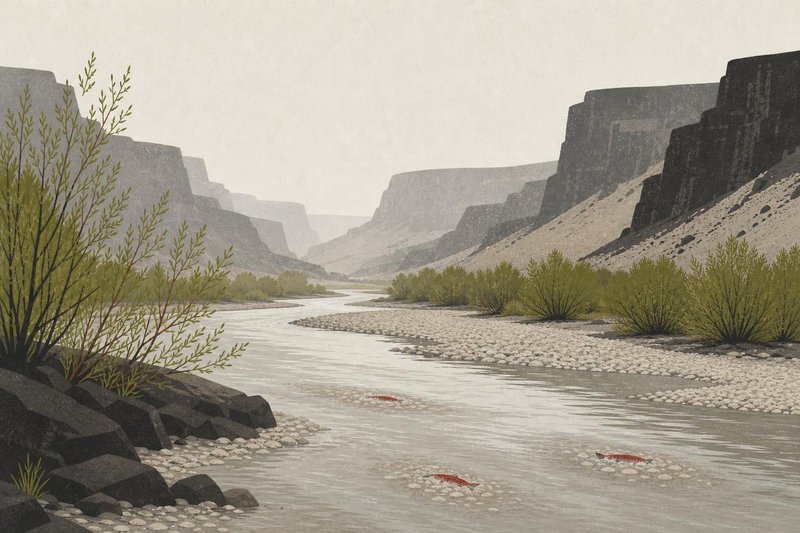
Snake River restoration means different things to different people. For a county conservation district it may mean a few miles of replanted streambank on a tributary. For Columbia Basin tribes and many conservation groups it means a free-flowing lower Snake River. Every serious plan shares the same goal, salmon and steelhead runs large enough to be harvested again, and differs on how far it is willing to go to get there. This guide compares the main approaches to lower Snake River restoration and what stands behind each.
What any restoration plan has to solve
Snake River salmon face losses at every stage of their life. Spawning streams lost habitat to grazing, logging, mining and water diversions. Young fish migrating to the sea pass eight federal dams and their reservoirs. In the ocean they face changing temperatures and food supply, and on the way back they meet fisheries, warm water and the same dams again. A plan that improves one stage while ignoring the others has, historically, produced modest results.
From Lewiston the fish continue upstream on free-flowing rivers: sockeye bound for Redfish Lake travel about 440 more miles and climb roughly another 5,800 feet, to about 6,500 feet above sea level. Elevations are approximate normal maximum pool levels.
Plan one: restore salmon habitat with the dams in place
This is the approach federal agencies have followed since the first listings in the early 1990s. It combines habitat projects in Idaho, Oregon and Washington tributaries with better passage at the dams, spring spill to carry young fish over the spillways rather than through turbines, predator control and hatchery reform, plus spring Spill Water released over a dam's spillway instead of through its turbines. Glossary over the dams. The Bonneville Power Administration funds much of the work through its fish and wildlife program.
Supporters point to improved survival through the hydro system and to local habitat gains. Critics, including several federal court rulings over the years, have argued that the measures were not enough to put the runs on a path to recovery rather than slow decline.
Plan two: breach the dams and replace their services
The most ambitious Snake River restoration plan, Breaching Removing the earthen part of a dam so the river can flow around the concrete. Glossary, would remove the earthen embankments of Ice Harbor, Lower Monumental, Little Goose and Lower Granite and let roughly 140 miles of river run free. On its own that would end barge navigation to Lewiston and remove a block of flexible hydropower, so every version pairs breaching with replacement investments.
The best-known version is the Columbia Basin Initiative, published in 2021 by Idaho Congressman Mike Simpson. It priced the package at $33.5 billion, including payments to utilities and ratepayers, grain transport upgrades, redevelopment of the Lewiston-Clarkston riverfront, and funding for tribes and fish and wildlife programs. In 2022 a report commissioned by Senator Patty Murray and Governor Jay Inslee put the cost of replacing the dams' services at $10.3 billion to $27.2 billion and concluded that breaching should follow, not precede, those replacements.
Plan three: a negotiated salmon restoration package
In December 2023 the federal government, Oregon, Washington and four tribes, the Nez Perce, Umatilla, Warm Springs and Yakama, signed an agreement that paused litigation over dam operations. It committed federal funding to salmon restoration and to tribally sponsored clean energy projects, and called for studies of how the dams' services could be replaced if Congress ever chose to breach them. It did not itself remove any dam. In June 2025 the federal government withdrew from the agreement, and the litigation it had paused was set to resume.
Comparing the plans
| Plan | Dams | Main backers | Status |
|---|---|---|---|
| Habitat, passage and spill | Stay | Federal agencies, utilities, many farm groups | In effect, under court supervision |
| Breach and replace services | Partially removed | Tribes, conservation and fishing groups | Proposals only; needs Congress |
| Negotiated 2023 package | Stay, with replacement studies | Oregon, Washington, four tribes | Federal withdrawal in 2025 |
What lower Snake River restoration would look like on the ground
River scientists expect a breached lower Snake to drop back toward its old channel within months, exposing sediment that has settled in the reservoirs since the 1960s. Replanting and erosion control would follow. The Elwha River on the Olympic Peninsula, where two dams came out between 2011 and 2014, is the regional reference: salmon reached the upper river within a few years, though the Elwha is far smaller and its dams served fewer uses.
For salmon, the expected gains of lower Snake River restoration are faster migration, cooler water and fewer passage losses. How large those gains would be is still modeled, not measured, and that uncertainty is one reason the Snake River restoration debate has lasted as long as it has.
Questions about Snake River restoration
What is the difference between Snake River restoration and dam removal?
Dam removal is one possible piece of Snake River restoration. Restoration also covers habitat work in tributaries, changes to hatcheries and harvest, cooler water through shade and flow, and the investments meant to replace what the dams provide. Some plans include breaching; others aim to recover salmon with the dams in place.
What was the Columbia Basin Initiative?
A $33.5 billion concept published in 2021 by Idaho Congressman Mike Simpson. It proposed breaching the four lower Snake River dams later in the decade and paired that with payments and programs for energy, agriculture, ports, communities and tribes. It was never introduced as a bill but reshaped the debate.
Which plan for the lower Snake River restoration is in force today?
None of the breaching plans has been adopted. Day-to-day operation of the dams follows federal biological opinions and court-supervised spill. A 2023 agreement that paused litigation and promised restoration funding was abandoned by the federal government in 2025.
Does habitat restoration alone help salmon?
Habitat work improves survival in the streams where fish spawn and rear, and many projects have shown local gains. Most fisheries scientists consider it necessary but not sufficient for Snake River salmon, because the largest losses happen during migration and at sea.