Snake River steelhead: the sea-run rainbow trout of Idaho
Steelhead are rainbow trout that go to sea. Their fall return to Idaho's rivers built a fishing tradition, and a guiding economy, in towns along the Clearwater and Salmon.
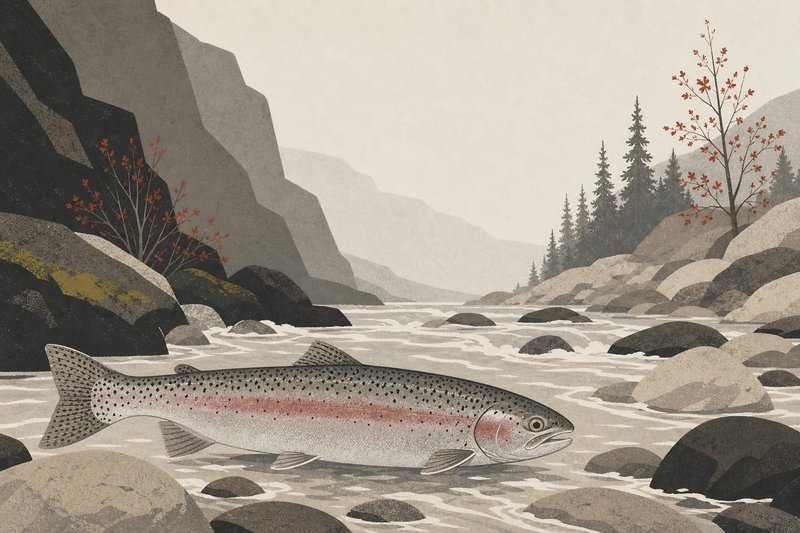
Steelhead (Oncorhynchus mykiss) are rainbow trout that migrate to the ocean and return to fresh water to spawn. Snake River Basin steelhead spawn in tributaries across Idaho, northeastern Oregon and southeastern Washington, and were listed as Threatened and endangered Protection levels under the Endangered Species Act. Glossary under the Endangered Species Act in 1997. Like salmon, they pass eight federal dams in each direction.
A trout that goes to sea
Young steelhead spend one to three years in fresh water before migrating to the sea as Smolt A young salmon turning silver and ready to migrate to the sea. Glossary in spring. Managers sort the returning adults into two groups. A-run steelhead usually spend one year in the ocean and come back smaller, typically 4 to 8 pounds. B-run steelhead usually spend two years at sea and return larger, often over 10 pounds; most spawn in the Clearwater and parts of the Salmon River basin.
Unlike Pacific salmon, steelhead do not always die after spawning. Some survive and head back downstream, and a few return to spawn again, though in the Snake River basin the distance and the dams make that rare.
A long stay in the river
Snake River steelhead pass Lower Granite Dam mainly from late summer through fall. Many then hold in the river through the winter and finish their journey in early spring, when they spawn as snowmelt begins. That is why a calendar-year count at the dam rises steeply from August and why some fish appear in the counts again in March and April.
Source: Columbia River DART, adult passage counts at Lower Granite Dam, 2025.
Wild and hatchery steelhead
Hatcheries release millions of young steelhead into the Snake River basin each year to support fisheries and to offset losses at the dams. Dworshak National Fish Hatchery, at the mouth of the North Fork Clearwater, is a major source of B-run steelhead. Hatchery fish have their adipose fin clipped, which lets anglers and counting stations tell them apart from wild fish. Only wild, naturally spawning steelhead count toward recovery under the Endangered Species Act, and their numbers have stayed well below recovery goals.
What limits the runs
Young steelhead migrate to the sea in spring alongside Chinook and face the same reservoirs and dams, along with Spill Water released over a dam's spillway instead of through its turbines. Glossary and Fish transportation Collecting young fish at a dam and carrying them downriver by barge or truck. Glossary meant to improve their survival. In the Columbia estuary, colonies of Caspian terns and double-crested cormorants have taken a large share of migrating steelhead smolts in some years, and management programs have worked to move or shrink those colonies. Ocean conditions matter too: an unusually warm patch of water in the northeast Pacific from 2014 to 2016 was followed by some of the weakest returns on record. For spawned-out adults heading back to the sea, the dams are a further obstacle, which is one reason repeat spawners are so rare in the Snake River basin.
Steelhead country
The fall and spring steelhead seasons built a fishing tradition in towns such as Orofino, Riggins and Salmon, where guides and outfitters depend on the runs. Most of the fish that anglers may keep are Hatchery and wild fish Fish raised in a hatchery versus fish born in a stream. Glossary; wild fish must be released.
Counts at Lower Granite Dam peaked at 323,697 steelhead in 2009 and have been far lower in recent years, which has led state managers to shorten or restrict seasons. This season's numbers are on the fish counts page, and the people who depend on the runs are profiled in who depends on the river.
Questions about Snake River steelhead
Is a steelhead a salmon or a trout?
Steelhead are rainbow trout that migrate to the ocean, the same species (Oncorhynchus mykiss) as resident rainbows. They are managed alongside salmon because they share the same rivers, dams and ocean migration.
What are A-run and B-run steelhead?
Managers divide Snake River steelhead into A-run fish, which usually spend one year at sea and return smaller and earlier, and B-run fish, which usually spend two years at sea and return larger and later. B-run fish are found mainly in the Clearwater and parts of the Salmon River basin.
Do steelhead die after spawning?
Not always. Unlike Pacific salmon, steelhead can survive spawning and return to the sea. In the Snake River basin, the long journey and the dams mean that only a small share of spawned-out fish, called kelts, make it back.
Can I keep a wild steelhead?
In Idaho, Washington and Oregon, anglers may generally keep only hatchery steelhead, recognized by a clipped adipose fin; wild fish must be released. Seasons and limits change from year to year, so check the current state regulations.